You’ve seen this pattern before: One SKU sells a lot, another stalls, and your planning team spends the week explaining why the numbers changed. Instead of working from a strong baseline, planners end up chasing exceptions, adjusting spreadsheets, and reacting to demand after shifts.
That’s where demand forecasting gives you a better starting point, by helping estimate future demand early enough to make smarter inventory, production, purchasing, and capacity decisions.
In this guide, we’ll cover the main types of demand forecasting, the methods behind them, and the situations in which each works best. You’ll also see common forecasting challenges, practical ways to improve forecast performance, and how AI helps you move faster with better signals.
Key highlights:
- Demand forecasting is the practice of projecting future demand so teams can plan inventory, production, purchasing, staffing, and capacity.
- Types of demand forecasting include short-term, long-term, macro-level, micro-level, passive, active, internal, external, AI-driven, new-product, and intermittent.
- Common methods of forecasting demand are qualitative, quantitative, and AI-driven approaches.
- Demand Forecast AI improves the baseline for your forecasts and supports human + AI collaboration, providing you with actionable insights for your supply chain.
Demand forecasting definition
Demand forecasting is the process of estimating future customer demand over a defined period. You can use this procedure to plan inventory, production, procurement, and capacity with greater accuracy by leveraging historical data, current signals, and business context to predict demand shifts.
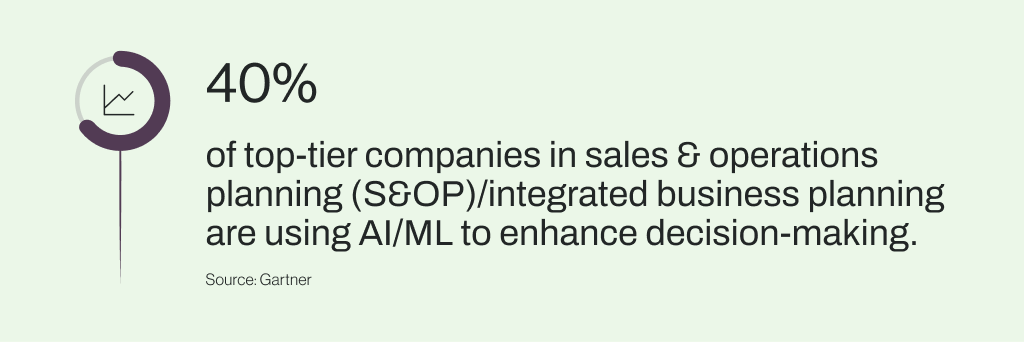
For those aiming for excellence, the prediction process became a competitive differentiator. According to Gartner, 40% of high-performing companies in S&OP/Integrated business planning use demand forecasting with AI/ML to optimize decisions.
Types of demand forecasting with examples
Forecasts have many purposes: They can help teams manage short-term execution, such as replenishment and production scheduling, or support longer-term business decisions — capacity planning, budgeting, and sourcing strategy included.
That’s why businesses often use several types of demand forecasting at once. The right choice depends on the time horizon, the level of detail, and the planning question you need to answer. Take a look at the main options and where they fit in practice:
| Demand forecasting types | Timeline | Best for | Demand forecasting examples |
|---|---|---|---|
| Short-term | Days to approximately 13 weeks | Replenishment, workforce planning, and near-term production scheduling | Forecast the next 4 weeks of SKU-store demand to set reorder points and safety stock |
| Long-term | Around 3 months to 2+ years | Capacity planning, supplier contracts, budgeting, and network planning | Forecast the next 12 months’ demand for a product family to plan production capacity |
| Macro-level (external) | Typically quarterly to multi-year (can be monthly) | Market sizing, category growth, and region/country planning | Forecast total category demand in a region to plan expansion and distribution footprint |
| Micro-level (internal) | Daily/weekly/monthly, SKU-by-location | Inventory optimization, allocation, and fulfillment performance | Forecast demand weekly to optimize allocation and reduce stockouts |
| Passive | Usually short to medium term (weeks to months) | Stable products with consistent historical patterns | Use last year’s weekly sales pattern + trend to forecast staple items |
| Active | Short to long term (weeks to years) | Products impacted by promos, pricing, new channels, and product changes | Adjust forecast using planned promotion calendar + price changes + planned distribution |
| Internal (company-driven | Short to medium term (weeks to months) | Demand driven by internal actions (promos, launches, assortment, distribution) | Forecast uplift for a promotion campaign to plan inventory and labor |
| External (market-driven) | Medium to long term (months to years) | Demand sensitive to macro conditions, seasonality, weather, and competitor moves | Forecast seasonal demand using economic conditions + seasonality indices |
| AI-driven | Short to long term (days to years), often multi-horizon | Complex demand patterns, many drivers, large SKU counts, and reducing manual effort | Adopt an ML model that uses history + promo + price + calendar effects to generate SKU-store forecasts with confidence bands |
| New product/lifecycle | Pre-launch to approximately 6-12 months post-launch | New SKUs with limited history, substitutions, and ramp-up planning | Forecast a new demand using comparable SKUs + distribution ramp + early sales signals |
| Intermittent (lumpy) | Weekly/monthly over 3-12+ months | Spare parts, B2B reorder items, and low-volume SKUs | Forecast spare part demand using intermittent-demand models to prevent costly stockouts |
Demand forecasting methods
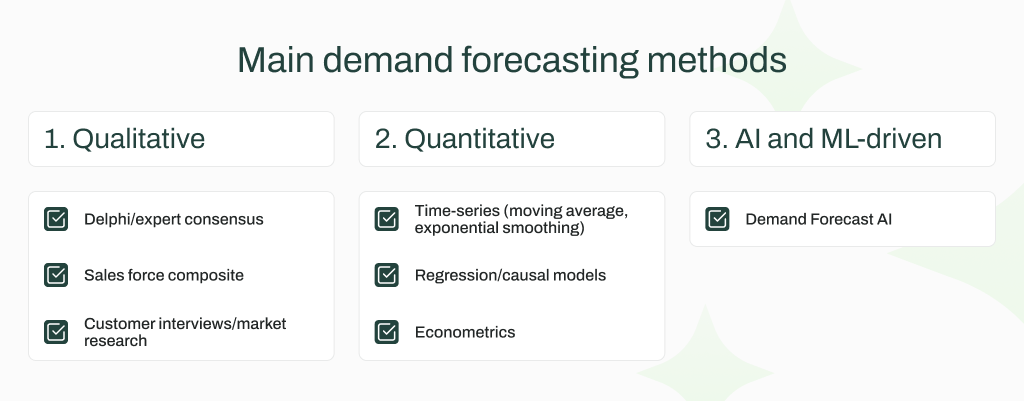
The most common demand forecasting methods fall into three groups: qualitative, quantitative, and AI-driven. Most companies don’t rely on a single demand forecasting technique across every product or planning scenario. They use a mix of approaches, depending on whether they’re forecasting stable items, new products, promotion-driven demand, or categories affected by external factors.
Qualitative methods (when data is limited)
Qualitative forecasting methods rely on judgment, experience, and market knowledge rather than large volumes of historical demand data. These approaches are useful when you’re forecasting the demand for a new product, entering a new market, or facing demand conditions that historical sales alone can’t explain.
- Delphi method/expert consensus: A structured method that combines input from multiple experts to build a forecast through iterative review.
- Sales force composite: An estimate from sales teams who know their accounts, territories, and near-term demand signals.
- Customer interviews/market research: A forecast informed by direct customer feedback and market conditions, often used when you have limited historical data.
Qualitative methods are valuable, but they can also be inconsistent if not carefully structured. They work best as a complement to a forecast baseline, not as the only forecasting approach.
Quantitative methods (core statistical approaches)
Quantitative forecasting methods use historical sales data and mathematical models to estimate future demand. They’re the foundation of many predictive processes because they provide a consistent, repeatable starting point for planning.
- Time-series (moving average, exponential smoothing): Statistical methods that project future demand from historical patterns such as level, trend, and seasonality.
- Regression/causal models: Forecasting methods that estimate demand based on the effect of drivers such as price, promotions, holidays, or weather.
- Econometrics (when you have macro drivers): A model that links demand to broader economic factors such as inflation, unemployment, or commodity prices.
These quantitative methods are often effective for established products with enough clean history. But you can struggle by using them when demand is highly volatile, when multiple signals interact at once, or when planners need more granularity across many SKUs, channels, or locations.
AI and machine learning methods (modern approach)
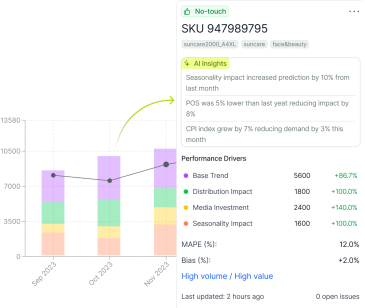
Machine learning and AI methods go beyond purely qualitative and quantitative approaches by processing multiple signals at once. Besides looking at historical data, an AI tool like Demand Forecast uses ML to compare past demand with the conditions around it, such as price, promotions, seasonality, and channel changes, to learn which combinations lead to higher or lower sales.
For example, say a snack brand wants to forecast next month’s demand. For each past week, an AI model can see:
- Units sold
- Whether there was a promotion
- The discount level
- The retailer or channel
- The region
- The time of year
- Whether demand spiked before a holiday
From that history, AI can learn patterns such as:
- Promotions lift demand more in supermarkets than in convenience stores.
- A 5% discount barely moves sales, but a 15% discount creates a spike.
- Summer boosts some SKUs, but only in certain regions.
- Holiday demand rises only when the product also has strong shelf placement.
Still, AI does not replace a planner’s judgment. Your model may detect patterns in the data, but it may not know that a major customer plans to cancel an order or that a sales team just secured unexpected volume. The strongest forecasting process uses ML to improve the baseline, then relies on planners to add the business context that the model can’t see yet.
Common demand forecasting challenges (and how to actually fix them)
The challenges of demand analysis and forecasting are rarely the math alone. Main issues include process gaps, data quality, or trust breaches that show up in the numbers later. For example, AlixPartners’ Consumer Sentiment Index points out that two-thirds of consumers will leave an online or physical store and shop elsewhere if the product they’re looking for isn’t available — an issue that might not exist with proper demand forecasting.
| Demand forecasting issues | What it looks like | How to fix | KPI to monitor |
|---|---|---|---|
| Data quality gaps | Missing history, wrong units, duplicate SKUs | Standardize masters and automate validation rules | Data completeness (%) |
| High volatility | Errors spike on promos, holidays, and disruptions | Split baseline vs. uplift and add event calendars | Event-period error |
| Persistent bias | Systematic over/under-forecasting | Track bias by segment and govern overrides with reasons | Forecast bias (%) |
| Organizational misalignment | Teams disagree and ignore the forecast | Set one cadence, RACI, and a single consensus number | Forecast adoption (%) |
| Low model trust | “Black box” doubt or blind over-trust | Publish confidence tiers and share backtests | Adoption by tier |
| Too much manual effort | Planners review everything, including low-impact SKUs | Segment SKUs and run no-touch + exception queue | Planner hours per cycle |
How to choose the right demand forecasting software
The right demand forecasting software should improve forecast quality without adding complexity to your planning process. Look beyond feature lists and focus on whether the tool can handle your data, fit your workflow, and support better decisions at scale.
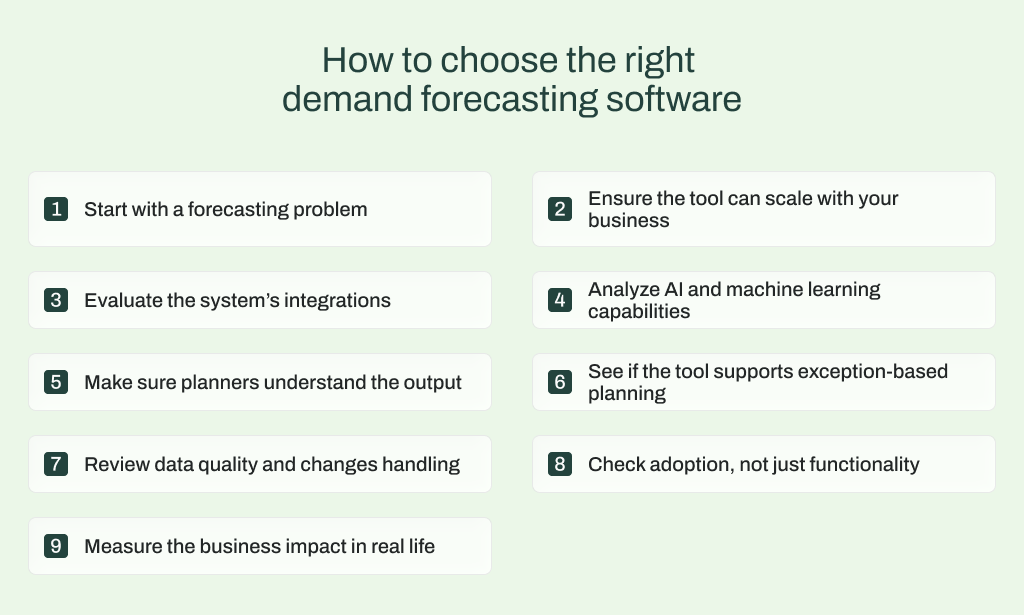
Start with your forecasting problem
Before you compare vendors, define what the software needs to solve. You might need better SKU-level forecasting, faster planning cycles, fewer manual overrides, or better visibility into forecast changes.
The best demand forecasting software will turn your problem or question into reliable forecasts, without the hassle of building a model on your own. A clear use case also makes it easier to judge if a tool will fit your process or just add another layer of technology.
Make sure the tool can scale with your business
A forecasting tool should handle growth in data volume, product count, channels, and planning complexity without slowing your team down. What works for a small product set may break under thousands of SKUs, multiple regions, or frequent forecast updates.
Look for software that can support both current needs and future expansion.
Evaluate the system’s integrations
Your demand forecasting software needs to connect with the systems that already hold your planning data. Main integrations for this kind of tool include:
- Enterprise resource planning (ERP)
- Customer relationship management (CRM)
- Point of sale (POS)
- Inventory planning
- Pricing software
- Promotion systems
Strong integration reduces manual work, improves data flow, and facilitates the use of forecasts inside the workflows your team already runs.
Analyze AI and machine learning capabilities
Not every forecasting platform uses AI in a way that adds value. Ensure your choice of software can improve the baseline forecast by:
- Analyzing multiple demand signals, weighing factors such as sales history, promotions, pricing, seasonality, channel shifts, and external inputs at the same time.
- Adapting to changing patterns, detecting shifts in demand behavior, and updating the forecast baseline rather than relying on outdated assumptions.
- Helping your team focus on exceptions by flagging products, periods, or regions where confidence is lower, or demand is changing enough to require planner review.
The goal is not to buy AI for its own sake, but to use it where it improves forecast quality and planner productivity.
Make sure planners can understand the output
Ask your planning team to evaluate the software. A forecast becomes more useful when planners can see what changed and why, so count on your team to look for tools that provide explainability, confidence signals, and clear visibility into forecast drivers.
When you have these capabilities, it’s easier to trust the output, challenge it when needed, and make better decisions without treating your model like a black box.
See how well the tool supports exception-based planning
Exception-based workflows help planners review only the forecasts that show meaningful risk, change, or uncertainty. Forget about losing precious planning time checking every SKU, region, or account in every cycle.
A system that allows exception-based planning flags the items that need attention, such as:
- Sudden demand spikes
- Large forecast changes
- Low model confidence
- Mismatches between the forecast and recent business activity
Ensure your software includes this capability, freeing planners to focus on decisions where human judgment adds value.
Review how the solution handles data quality and changes
Demand data isn’t perfect: Products change, channels shift, promotions distort history, and new items offer very limited signals. Your forecasting software should help teams manage:
- Noisy inputs (missing sales records, duplicate transactions, stockout-distorted demand, or promotion-driven spikes)
- Changing demand patterns (channel shifts, price changes, and regional growth)
- Edge cases (new products, intermittent demand, and low-volume SKUs)
Strong forecasting software should handle those cases in a structured way — not treat them like standard demand history.
Check adoption, not just functionality
A tool can look strong in a demo and still fail in practice if planners don’t use it. Make sure the chosen software fits the way your team works, shortens time-to-value, and supports clear handoffs among planning, supply chain, and commercial teams.
Adoption matters because unused forecasts can’t improve business outcomes.
Measure the business impact in real life
Forecast accuracy improvements aren’t the only success metric you should watch for. A proper demand forecasting tool must help your business:
- Reduce stockouts
- Limit excess inventory
- Shorten planning cycles
- Improve service decisions
Set a trial period and then evaluate your tool based on the operational outcomes it can influence.
Demand forecasting best practices: How to get started
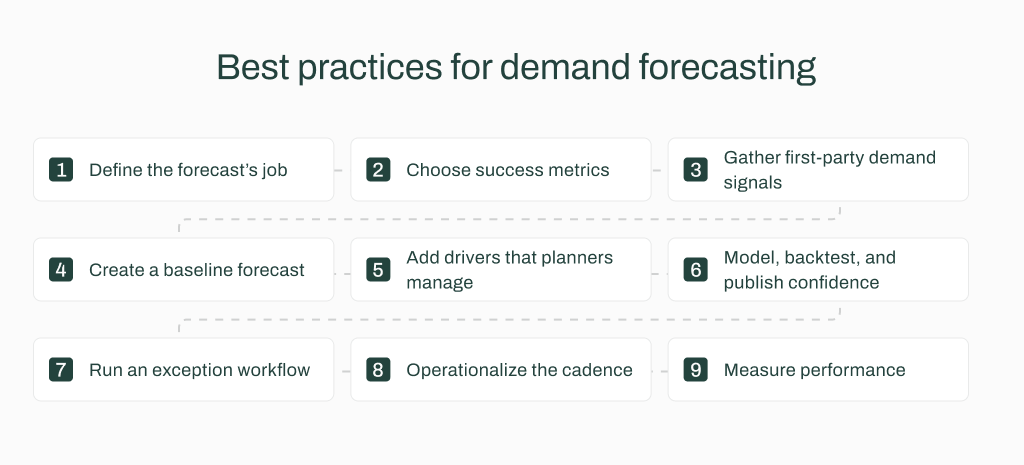
The most effective way to start is to treat demand forecasting as an operating process instead of a one-time model build. Here are the nine best practices that give you a practical path from raw data to a final forecast:
- Define the forecast’s job: Specify the decision (initial buy, production, replenishment, capacity), the horizon (4-52 weeks), and the granularity (SKU-location-week, family-week, channel-week).
- Choose success metrics before you build anything: Pick accuracy (wMAPE or MAPE), bias, and one business outcome metric (stockouts, inventory days, or service level). Add forecast value added (FVA) if planners will adjust the baseline.
- Gather first-party demand signals: Pull shipments, orders, POS (if available), returns, and catalog history. Keep a clear definition for “demand,” so all teams can read the number the same way.
- Create a baseline forecast: Use seasonality and trend for established items. For sales forecasting of a new product, go with analog products plus a distribution ramp, promo calendar, and pricing plan to form the first baseline.
- Add drivers that planners already manage: Include promotions, price changes, channel mix shifts, distribution milestones, and supply constraints. Keep assumptions explicit so leaders can approve tradeoffs.
- Model, backtest, and publish confidence: Train an AI model, then backtest on analog periods or prior launches. Publish confidence by segment so the team can separate “no-touch” items from “needs-review” products.
- Run an exception workflow with human review: Route low-confidence, high-impact items to planners. Require a reason code for every override, then store the reason so you learn which adjustments actually help.
- Operationalize the cadence in S&OP: Refresh actuals weekly during launch, then review exceptions, update assumptions, and publish a consensus forecast.
- Measure performance and improve the system: Track wMAPE, bias, FVA, and adoption. Use error diagnostics to fix root causes such as promo data quality, wrong analog selection, or poor segmentation.
Learn how AI in supply chain can make demand forecasting less overwhelming.
Meet the AI that makes forecasting demand easy
Demand Forecast is a supply chain forecasting tool for those who need a stronger forecasting baseline without adding more manual work. Our AI predictive layer helps you and your planning teams improve forecast accuracy, reduce bias, and focus precious time on the items that actually need human review.
With Demand Forecast AI, you can:
- Improve baseline forecasts and drive more reliable, meaningful predictions for your supply chain.
- Achieve 15-30% greater accuracy than traditional methods.
- Leverage human expertise with AI collaboration to outperform competitors.
- Get proof of value in weeks/months, not years.
- Turn your first-party data into revenue.
Book a demo today and get the most out of your forecasts.

FAQs
Why is demand forecasting important in supply chain?
Demand forecasting is important for supply chain because predictions give planning teams a better estimate of what the business will need and when. This estimate shapes inventory targets, production schedules, purchase orders, labor plans, and capacity decisions before demand turns into a service or cost problem.
MAPE or wMAPE: What is the best forecasting accuracy metric?
The best forecasting accuracy metric depends on your business needs. MAPE measures the average percentage error between forecast and actual demand. WMAPE weights the error by sales volume, which makes it more useful when high-volume items should count more in the overall result.
Use MAPE to understand percentage error, and use wMAPE when you want the result to reflect business volume.
Demand planning vs. forecasting: What’s the difference?
While demand forecasting predicts what demand is likely to be, demand planning determines how the business should respond to that prediction. For example, a planner may generate a SKU-level forecast for next month to estimate demand for a product in one region — that’s forecasting. Then you can use that information to set inventory targets, align production, review service risk, and adjust for a planned promotion — that’s demand planning.
What is demand forecasting in supply chain management?
Demand forecasting in supply chain management is the process of matching supply to expected demand across inventory, production, procurement, and distribution. By improving replenishment, inventory, production timing, and material planning, supply chain businesses reduce stockouts, overstocks, expediting, and service risk.
What are the main components of demand forecasting in supply chain?
The main components of demand forecasting in the supply chain industry include:
- Historical demand data: Past sales patterns
- Forecast horizon: Planning time frame — days, weeks, or months
- Level of detail: Forecast granularity — SKU, channels, or locations
- Demand drivers: Demand-shaping factors such as seasonality, promotions, or weather
- Forecasting models: Tools that provide predictions based on different methods
- Performance metrics: Accuracy reviews based on KPIs
- Planner review: Human validation of the predictive models
Read more about human and AI collaboration in supply chain.