If you work in supply chain operations, you know that effective planning is the backbone of the business. Accuracy is everything, and making decisions about inventory, logistics, and resource allocation without reliable data is just a guess. To stay competitive, you need the best supply chain forecasting tools available.
In this buyer’s guide, we will explore the top technology and techniques that move your inventory planning from reactive to proactive, helping you to meet immediate demand and anticipate future market shifts.
| Top supply chain forecasting tools | Key features |
|---|---|
| Demand Forecast AI |
|
| Blue Yonder |
|
| Amazon SageMaker Canvas |
|
| Azure Machine Learning |
|
| Kinaxis |
|
| Databricks AutoML Forecasting |
|
| DataRobot |
|
| Anaplan |
|
| H2O |
|
| Dataiku |
|
| RELEX |
|
What are supply chain forecasting tools?
Supply chain forecasting tools are advanced software solutions that use data analysis, statistical modeling, and machine learning to predict future logistics activities, ranging from product demand and lead times to potential supply disruptions. These tools ingest and harmonize data from countless sources, including:
- ERP systems
- Sales data
- Customer behavior
External factors, such as weather or economic indicators
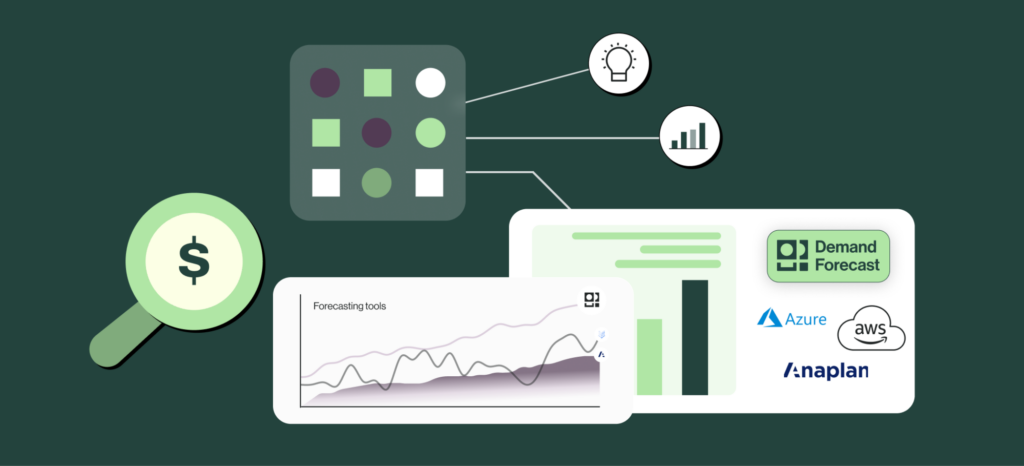
The best global supply chain forecasting tools do much more than replace spreadsheets. They help you turn your data into actionable insights, such as identifying churn patterns or new upsell opportunities. With these tools, you can stay ahead of bottlenecks and surpluses by optimizing stock, planning production, and monitoring supplier performance before issues arise.
An Anvyl report revealed that 22% of respondents have significantly increased their spending on supply chain tools, with those making investments expressing greater confidence in their capacity to handle disruptions successfully.
11 best supply chain forecasting solutions
Every supply chain solution has its own strengths, helping you build a more informed and agile business. Let’s take a look at the 11 top options that can help you forecast with more confidence.
1. Demand Forecast AI
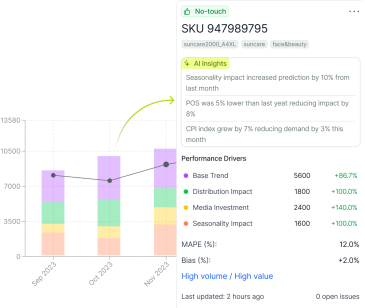
Demand Forecast AI, a Pecan product, provides demand projections for supply chain leaders. Planners can use these projections within IBP (Integrated Business Planning) or S&OP (Sales and Operations Planning) cycles. This forecasting solution offers explainable, accurate predictions without coding or data science work.
This industry-specific solution provides model explainability for supply chains, so you know where to intervene and when to leave a forecast alone, instead of defaulting to blanket manual overrides. The tool also calls out blind spots, such as new and seasonal items, as well as oversimplified models that miss real-world drivers.
Demand Forecast AI pros:
- Purpose-built experience for demand planning workflows, not a general ML workbench
- Adoption-friendly trust signals that help planners focus effort on exceptions
- Monitoring features that support ongoing forecast operations after launch
Book your Demand Forecast demo today.
2. Blue Yonder
Blue Yonder offers supply chain planning and execution software across areas such as demand planning, replenishment, warehouse and transportation management. Teams often pair Blue Yonder with an ERP for finance and system-of-record needs, then use Blue Yonder to support planning and execution workflows.
Blue Yonder pros:
- Suite coverage across planning and execution
- Workflow fit for demand, replenishment, and fulfillment
- Enterprise integration options
Blue Yonder cons:
- Longer rollout timelines when adopting multiple modules at once
- Higher operating effort for configuration across business units
- More change management work
3. Amazon SageMaker Canvas
Teams use Amazon SageMaker Canvas as a supply chain forecasting tool when they already store planning data in AWS and want analysts to build models without writing code. Canvas supports demand forecasting, late-delivery risk scoring, and inventory risk models when integrating structured datasets such as orders, shipments, inventory, and promo calendars.
Amazon SageMaker Canvas pros:
- Experimentation for teams that already run data pipelines in AWS
- Clear path to production via SageMaker workflows
- Enterprise-friendly access control through AWS IAM
Amazon SageMaker Canvas cons:
- Steep learning curve and workflow complexity, especially around resource configuration and IAM permissions
- Pricing complexity and cost fluctuation when you run long jobs or leave resources running
- Product limits and troubleshooting constraints that can block edge-case workflows
4. Azure Machine Learning
Azure Machine Learning Studio gives Microsoft-first organizations a visual environment for training, deploying, and managing ML models. Azure ML supports demand forecasts, lead-time predictions, and supplier risk scoring when building datasets from ERP, WMS, OMS, and transportation events.
Azure Machine Learning pros:
- Identity, security, and governance alignment
- Multiple build paths across UI and engineering workflows
- Cost controls through Azure pricing options
Azure Machine Learning cons:
- Setup overhead across workspaces, permissions, and dependent Azure services
- Cost variability tied to compute, storage, and supporting services, which complicates budgeting
- Ongoing operational complexity when you only need a narrow forecasting workflow
5. Kinaxis
Kinaxis supports concurrent planning, with a focus on scenario analysis and replanning across demand, supply, and inventory. The tool is an option when volatility drives frequent plan changes, and you need cross-functional alignment.
Kinaxis pros:
- Scenario planning that supports tradeoff analysis
- Cross-functional planning workflows
- Fit for frequent replanning during disruption
Kinaxis cons:
- Setup effort rises with complex constraints, hierarchies, and planning logic
- Output consistency depends on strong master data and shared definitions
- Training and process discipline drive adoption across planning groups
6. Databricks AutoML Forecasting
Teams that store operational time series in a lakehouse and want forecasting experiments close to data engineering workflows might use Databricks’ AutoML forecasting. This feature supports demand forecasts, lead-time predictions, and network-level risk modeling.
Databricks AutoML Forecasting pros:
- Lakehouse workflows that connect data engineering and forecasting experiments
- Collaboration through shared notebooks, pipelines, and experiment tracking
- Support for teams that already standardize data and compute in Databricks
Databricks AutoML Forecasting cons:
- Steep learning curve and platform complexity for teams without Spark and Databricks experience
- Costs that rise quickly at scale, plus cost transparency challenges without strong monitoring
- Consumption pricing tradeoffs, including higher DBU rates for serverless options
7. DataRobot
DataRobot is an automated model training platform that offers enterprise deployment and governance across forecasting problems. This tool supports demand forecasting, churn-like stockout risk scoring, and supplier delay risk modeling when you feed structured supply chain datasets into the platform.
DataRobot pros:
- Automation to operationalize predictions
- Support for scaled model management
- Model governance tooling for enterprises
DataRobot cons:
- High price and an enterprise buying model that can limit access for smaller teams
- Adoption overhead that can stretch timelines in large environments
- Limited flexibility compared with code-first approaches for advanced customization
8. Anaplan
Anaplan handles planning and modeling across finance and operations, including supply chain planning scenarios. Teams use Anaplan to concentrate planning across demand, inventory, capacity, and budget.
Anaplan pros:
- Planning that links demand signals to financial and operational plans
- Collaboration and workflow controls for cross-functional planning cycles
- Modeling layer that supports what-if scenarios across inventory, capacity, and spend
Anaplan cons:
- Model design and maintenance require skilled model builders and governance discipline
- Large models can slow down when you expand dimensions across many SKUs, locations, and time buckets
- Forecasting teams often pair Anaplan with external ML tooling when they need advanced predictive models
9. H2O
H2O provides an AutoML product that builds models through automated feature engineering. The capability, known as Driverless AI, supports creating supervised learning datasets from demand history, promo calendars, inventory positions, and lead-time signals, then iterates across algorithms.
H2O pros:
- AutoML acceleration with engineering support
- Support for low-code tooling
- Multiple deployment options across environments
H2O cons:
- Enterprise-style licensing that usually requires quote-based pricing and procurement
- Learning curve when moving past defaults into tuning, governance, and deployment patterns
- Smaller reviewer footprint on major sites compared with larger platforms, which can limit buyer validation
10. Dataiku
Dataiku is a collaborative analytics and AI platform that supports data prep, modeling, and governance. Supply chain forecasting features include shared workflows across analysts and engineers for demand prediction, lead-time estimation, and disruption risk scoring using operational sources such as ERP, WMS, OMS, and transportation events.
Dataiku pros:
- Support to analysts and engineers in one workspace
- Workflow coverage from data prep through deployment
- Standardization across analytics projects
Dataiku cons:
- Heavy platform feel for small projects and narrow forecasting needs
- Steep initial learning curve for beginners
- High licensing costs that can block smaller companies and startups
11. RELEX
RELEX solutions focus on retail planning use cases such as demand forecasting, replenishment, and allocation. The tool supports store- and DC-level planning needs, coordinating with promotions, assortment changes, and local demand patterns.
RELEX pros:
- Retail-first fit for replenishment, allocation, and high-SKU environments
- Forecast visibility across stores, regions, and categories
- Exception-based workflows
RELEX cons:
- Might need investments to integrate POS, ecommerce, inventory, and promotions
- Forecast accuracy depends on clean promo history and stockout signals
- Rollouts require process alignment across stores, DCs, and planning teams
Main forecasting methods in supply chain
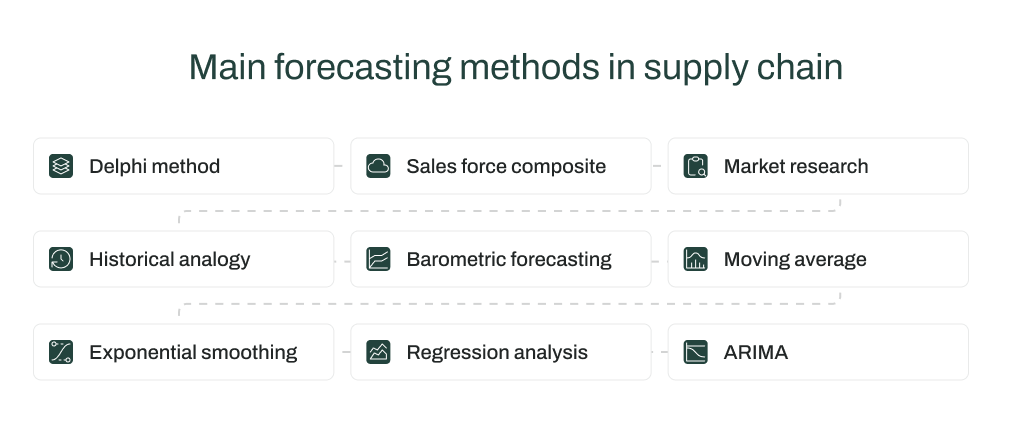
There are two traditional types of forecasting in supply chain management: qualitative and quantitative.
- Qualitative methods rely on human judgment when data is scarce or conditions change fast
- Quantitative methods lean on math and historical patterns when data stays consistent and clean
Most supply chain teams blend both approaches. For example, you might start with market research to forecast a new product launch, then move to a time-series model once you have a few months of sales data.
Qualitative forecasting methods in supply chain
Qualitative methods are effective in circumstances where historical patterns may not be reliable indicators of future events or when there is little to no history to draw upon. This approach allows researchers to explore nuances and gather insights in dynamic or poorly understood settings.
Key qualitative forecasting methods in supply chain include:
- Delphi method: Experts predict future sales or demand, using several rounds of anonymous surveys to help the group agree on the most likely outcome.
- Sales force composite: Sales reps gather insights from what they hear from customers and see in their territories to come up with a forecast.
- Market research: Use of surveys, interviews, or group discussions with potential customers to find out what people want, how much they might buy, or what features matter most.
- Historical analogy: Study of how a similar product or situation performed in the past to guess how a new product or market will do, especially when there’s not much current data.
- Barometric forecasting: Observation of early signals, like changes in online searches or store visits, to spot demand trends before they show up in actual sales.
Quantitative forecasting methods in supply chain
Quantitative methods are highly reliable when historical data displays consistent, repeatable patterns. Their empirical evidence allows supply chain teams to develop logic-based predictive models that generate assertive forecasts.
These forecasting techniques in supply chain management offer measurable error rates, enabling teams to assess forecast accuracy and implement necessary adjustments.
- Moving average: Method that takes the average of sales over the last few periods (like weeks or months) to create a simple prediction, best used when sales are steady.
- Exponential smoothing: Forecasting approach that puts more weight on the most recent sales, allowing predictions to adjust quickly as things change.
- Regression analysis: Tool for studying how factors like price, discounts, or advertising relate to sales, showing what might happen if those factors change.
- ARIMA: Model that finds patterns and trends in past sales data to predict the future, ideal for products with consistent sales over time.
Benefits of supply chain forecasting models
Supply chain forecasting models do more than just predict demand. They change how you allocate cash, capacity, and risk. McKinsey reported that AI-driven forecasting can reduce prediction errors by 20% to 50% in supply chain contexts, often resulting in downstream operational gains when teams act on time.
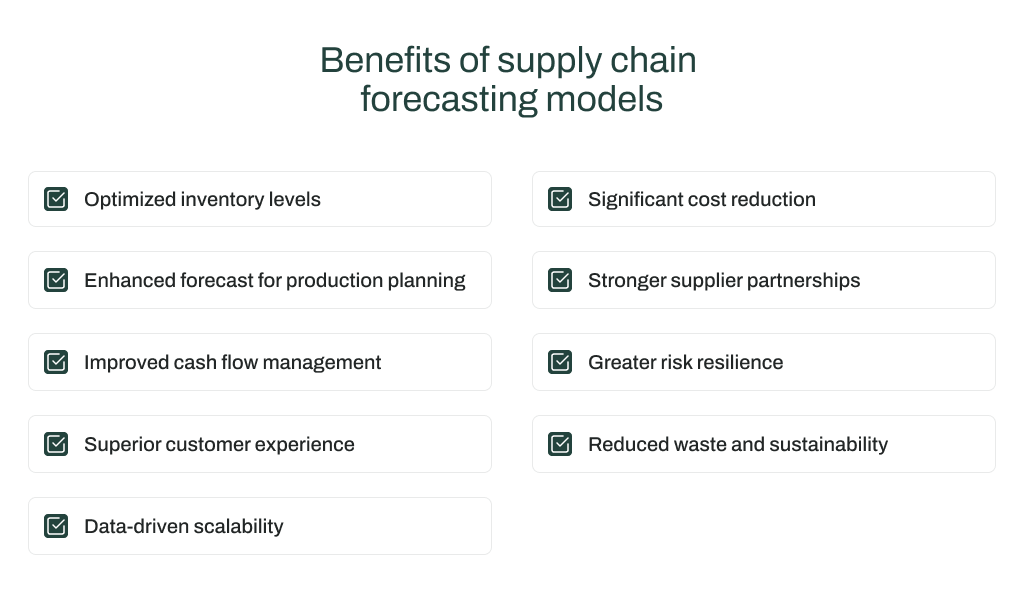
Here are nine practical benefits supply chain teams usually target:
- Optimized inventory management by aligning reorder points, safety stock, and service targets.
- Significant cost reduction by cutting expedite fees, obsolescence, and excess storage.
- Enhanced forecasts for production planning by locking capacity decisions earlier and with clearer confidence bands.
- Stronger supplier partnerships by sharing forward demand signals and stabilizing order patterns.
- Improved cash flow management by lowering working capital tied up in slow-moving inventory.
- Greater risk resilience by spotting demand shifts early and triggering contingency playbooks.
- Superior customer experience by reducing stockouts and late deliveries.
- Reduced waste and sustainability by avoiding overproduction and spoilage.
- Data-driven scalability by standardizing forecast workflows across categories, regions, and channels.
What are the most common supply chain forecasting challenges?
Supply chain forecasting is not generally easy. However, forecasting usually fails for predictable reasons. You can fix most issues with better data preparation for ML, stronger process design, and tighter integration into execution.
| Supply chain forecasting challenges | Impact | Solution |
|---|---|---|
| Demand volatility | Promotions, channel shifts, and macro swings can break historical patterns and make traditional forecasting methods unreliable. |
|
| Geopolitical and regulatory turbulence | Tariffs, trade routes, and compliance changes create uncertainty around lead times and supplier capacity. |
|
| Data fragmentation | Teams store signals across ERP, WMS, and spreadsheets, blocking clean data creation. |
|
| Siloed information | Marketing, Sales, and Ops have separate data, and a lack of alignment leads to mismatched signals. |
|
| Technological “debt” | Legacy stacks rely on brittle spreadsheet workflows that break under scale and volatility. |
|
| Supply chain tools integration | Forecasts that don’t reach replenishment or production scheduling fail to change outcomes. |
|
Leverage your supply chain predictions with Demand Forecast AI
At Demand Forecast AI, we are specialists in the challenges supply chain businesses face every day. Our AI predictive tool transforms the role of forecasting in supply chain operations by turning messy, real-world data into precise demand predictions. This transition from reactive to proactive data management allows your logistics team to pre-book capacity and align inventory with true market conditions.
Forget the need for a specialized data science team. Demand Forecast AI provides you with a production-ready supply chain forecasting tool so you can solve complex logistics challenges through simple, plain English conversations.
There’s no magic to the process; we do that simply by:
- Identifying true demand: We fix data gaps and handle anomalies, such as out-of-stocks, to ensure your forecast reflects what customers actually wanted to buy, not just what you had in stock.
- Looking beyond sales history: Our models account for the business drivers that move the needle, including promotions, pricing shifts, and inventory levels.
- Managing complexity at scale: We organize forecasts across your entire network, from broad regions down to specific SKUs and location hierarchies.
- Providing clear explanations: When a forecast changes, the system flags exactly why it happened, so your planners know when to take action and when to trust the numbers.
- Operating as a managed service: You get production-ready predictions and model maintenance without the need to hire or manage an internal data science team.
Take the first step toward a smarter supply chain operation with us. Book a demo now.

Frequently asked questions
What is forecasting in supply chain?
Forecasting is the process of anticipating demands, managing inventory, and optimizing operations through supply chain predictions. Far beyond simple guesswork, supply chain forecasting is a strategic function that uses historical data, current market trends, economic indicators, and predictive analytics to generate reliable estimates of what, when, and how much product customers will need.
Why are supply chain predictions important?
Supply chain predictions are important because they help you act earlier. Earlier action helps you plan inventory with less guesswork, plan capacity with fewer surprises, and protect service levels during demand swings.
How do supply chains measure demand forecasting success?
Supply chain teams typically track several key elements to ensure the efficiency and effectiveness of their operations. Main KPIs for demand planning include:
- Forecast accuracy (like MAPE)
- Forecast bias, service level
- Stockout rate
- Inventory turns
- Forecast value add (FVA)
You can also track business outcomes tied to the forecast, like working capital and expedited spend.
What are the top supply chain planning tools for retail?
Retail teams often rely on four key supply chain planning solutions to manage their operations and meet customer demands:
- ERP for execution
- Planning suite for demand and supply organization
- WMS (Warehouse management system) for warehouse operations
- BI layer for reporting
Retailers who take things to the next level usually add a predictive modeling layer for SKU-level forecasts that adapt faster than spreadsheets.
What is the best method of supply chain management forecasting?
The best demand forecasting methods in supply chain management really depend on your product, data quality, and how much things change. Most teams start with a simple baseline like exponential smoothing, then layer in causal drivers using regression or machine learning when factors such as promotions, pricing, or channel shifts start to move the needle.