Launching a new product puts your margins and reputation on the line. Your procurement squad needs to know how much to order, operations wants to get the timing right, and commercial teams expect products to be available from day one. But the biggest challenge is that you don’t have reliable historical sales data to guide your decisions.
Through our work with supply chain leaders, we’ve found that most teams fail because they treat demand forecasting for new products as a single task. In reality, the process consists of two distinct jobs.
- The first is how to forecast demand for a new product before its launch, when you have no direct sales history, which is a cold start problem.
- The second is how to forecast demand for a new product after launch, when you finally have some data, but not enough to rely on traditional forecasting methods alone.
These two situations require different inputs, model logic, and planner behavior. We’re here to help you solve both.
Key highlights:
- The demand forecasting process for a new product includes building a first-party data foundation, generating a baseline forecast, separating no-touch and touch workflows, and measuring implementation success.
- Industries such as CPG, manufacturing, food and beverage, e-commerce, oil and gas, and DTC brands benefit from streamlined processes for estimating future purchases of specific items.
- Demand Forecast AI uses technology to help you forecast the demand of a new product and maintain accuracy in your supply chain predictions.
What is product demand forecasting?
Product demand forecasting is the process of estimating how much of an item customers will buy over a given time period, at a useful planning level such as SKU, customer, channel, or region.
For established products, an accurate demand forecasting process includes analyzing historical patterns and adjusting for drivers such as promotions, price changes, holidays, weather, and market trends. For a new product, the job is harder because there is little or no direct history to learn from. That lack of information forces you to use a mix of analogy, launch assumptions, customer inputs, and adaptive modeling until the item builds its own signal.
The issue is that many traditional demand forecasting approaches break down in the process. According to McKinsey, close to three-quarters of supply chain functions still rely on spreadsheets for planning. But here’s the deal: Spreadsheet-heavy processes tend to rely on one-time estimates from sales or marketing, then need manual adjustments forever.
Not surprisingly, the same study shows that 90% of the planners polled want to implement new demand forecasting software in the next five years, while 23% have already done so.
AI demand forecasting steps for new products
Thanks to AI, you can predict the popularity of brand-new items in four practical moves. All you need is a demand forecasting solution equipped with artificial intelligence — and to follow these steps:
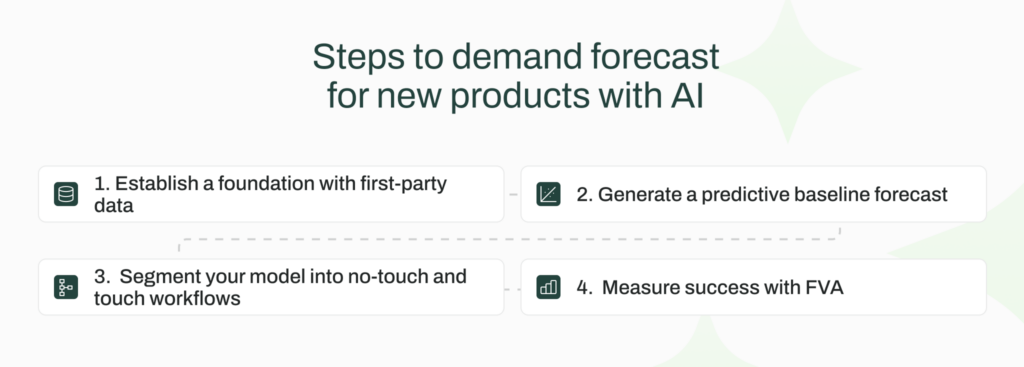
1. Establish a foundation with first-party data
While external factors, such as weather, can help forecast demand, 80% of the predictive signal typically comes from your first-party data. Try feeding your sales forecast tool with:
- Shipment invoices
- Orders and receipts
- Point-of-sale (POS) information
For new product demand forecasting, this foundation enables the AI to identify which existing items most closely resemble the new launch.
2. Generate a predictive baseline forecast
Once the data foundation is in place, the next step is to generate your baseline forecast with AI.
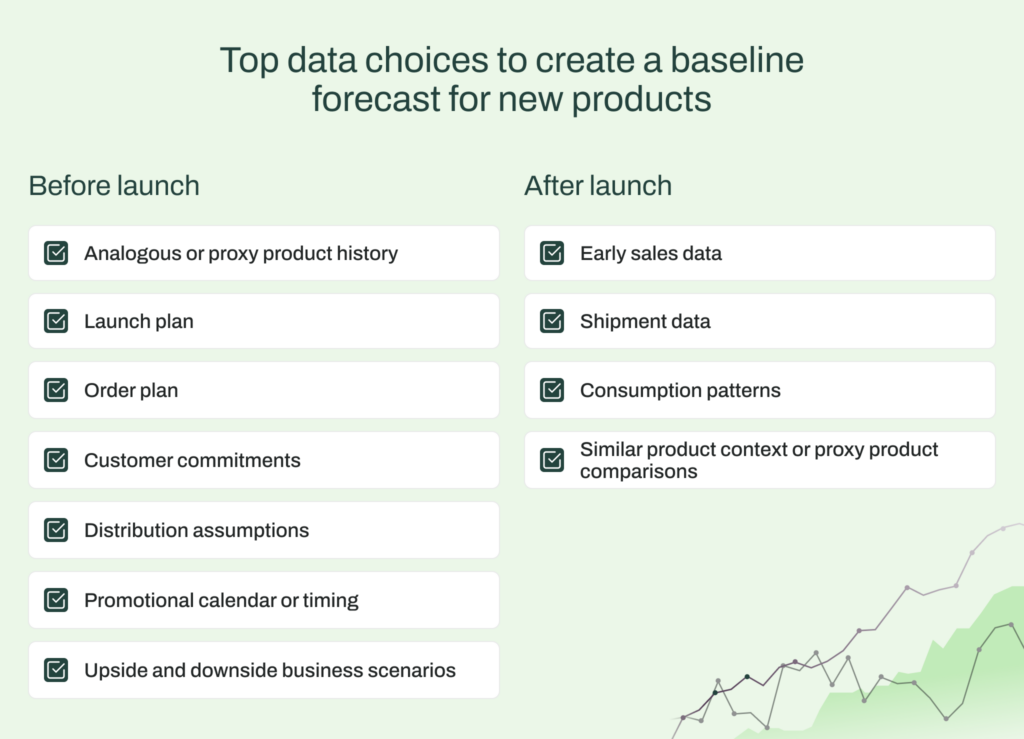
If you’re forecasting demand for new products before their launch, ensure your baseline combines at least some of these data:
- Analogous or proxy products
- Launch and order plans
- Customer commitments
- Distribution assumptions
- Known promotional timing
- Business scenarios for upside and downside risk
If you’re dealing with an after-launch forecast, the baseline should change. Now the product has early signals, but they are often hard to read because of short-term distortions, one-off events, and unstable patterns. In this case, your model should update more reactively using early sales, shipments, consumption patterns, and synthetic context from similar products.
3. Segment your model into no-touch and touch workflows
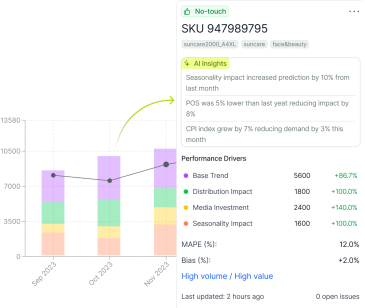
Not every new product forecast needs manual intervention. Some models generated by AI will be strong enough to adopt as-is. Others will need a planner review because the model has low confidence, unusual inputs, or incomplete information. No-touch and touch workflows make it easy to know when to trust the AI and when your team’s expertise matters most.
- A no-touch forecast is one that your team can accept without additional manual changes
- A touch forecast is where a planner should step in because local knowledge or recent business context can improve the outcome
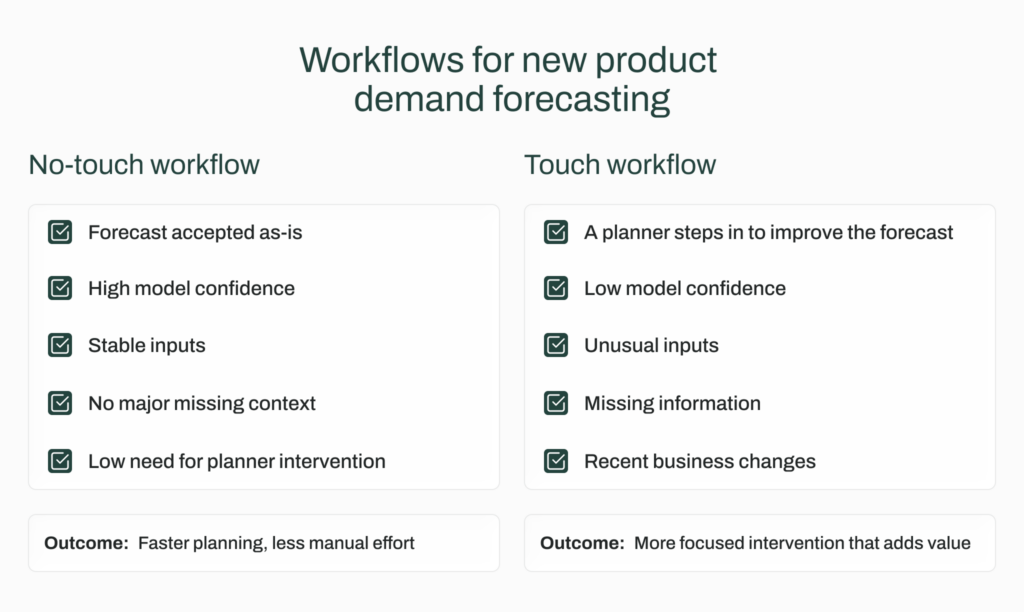
This segmentation helps to reduce time-consuming manual effort. If planners review every item equally, they waste time on forecasts that were already good enough and may introduce bias where no change was needed.
4. Measure success with forecast value add (FVA)
FVA measures whether the final forecast performed better or worse than the baseline one. In this process, the baseline is the model-generated prediction — before planners adjust it. The final forecast is the version that moves forward after any manual changes or consensus inputs.
FVA is especially useful for new product demand forecasting because early-stage items tend to attract a lot of attention, and planners often feel pressure to adjust launch forecasts frequently. That’s where this metric separates helpful interventions from unnecessary ones.
FVA answers three practical questions:
- Is the baseline forecast strong enough to trust more often?
- Are planners improving the forecast where they intervene?
- Which parts of the portfolio benefit most from manual input?
Over time, you can use FVA to refine where no-touch forecasting works, where touch forecasting adds value, and how to focus planner time more effectively.
Use cases on AI demand forecasting for new products
From manufacturing to demand forecasting for consumer goods, a handful of industries can use AI to predict demand. See examples divided by niches in the supply chain:
| Industry | New product demand forecasting use case | |
| Before launch | After launch | |
| Consumer Packaged Goods (CPG) | A CPG company may use similar SKUs, retail commitments, promo timing, and distribution plans to build the initial forecast. | The model shifts toward sell-through data, store-level adoption, and regional demand patterns. |
| Manufacturing | A manufacturer launching a new product variant may start with comparable product families, customer programs, and order expectations. | The forecast updates using order cadence, lead times, and short-term demand shifts. |
| Food and beverage | A food brand launching a seasonal product may lean on lookalike items, weather sensitivity, customer rollout plans, and promotional calendars before launch. | The company will need to distinguish pipeline fill from repeat consumer demand. |
| Oil and gas | An industrial supplier may forecast a new packaged offer using prior product families, contract expectations, and account plans before launch. | The model updates around project timing, regional changes, and customer buying patterns. |
| E-commerce | An ecommerce business launching a new product through marketplaces or digital retail channels may forecast demand using campaign plans, traffic expectations, price point, and similar product performance. | The model can adjust quickly based on clicks, conversion rates, consumer behavior, and channel-level demand shifts. |
| Direct-to-consumer (DTC) brands | A DTC brand launching a new product on its own site may forecast demand using customer history, subscriber behavior, preorder signals, and product affinity across past launches. | The forecast refinement can use onsite conversion, repeat purchase patterns, returns, and retention behavior. |
Want to implement these use cases through your enterprise? Discover the power of human and AI collaboration in supply chain.
Improve your demand forecasting process with AI
Forget about manual demand forecasting methods for new products. Demand Forecast AI helps supply chain teams build a stronger forecasting baseline, cut manual planning work, and focus attention where it matters most.
With Demand Forecast AI, you can achieve:
- Higher forecast accuracy across the portfolio
- Less manual planning work for demand teams
- Faster planning cycles and quicker decisions
- Better visibility into exceptions and demand changes
Book a demo now and discover the next level of supply chain-focused tools.