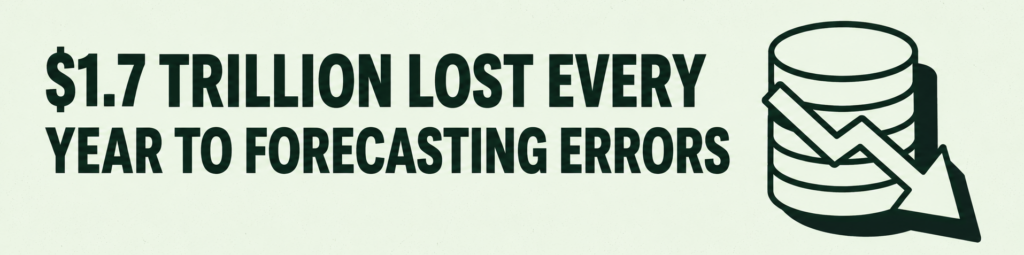
Businesses lose an estimated $1.7 trillion every year to forecasting errors, according to IHL Group, with retail stockouts and overstocks accounting for more than $1 trillion of those losses. Despite years of investment in planning software, machine learning, and AI, demand forecasting remains one of the industry’s biggest challenges.
As organizations begin embedding agentic AI into demand planning, replenishment, procurement, and inventory management, the cost of getting those predictions wrong only grows. AI can optimize inventory, recommend purchase orders, or rebalance supply across locations, but only if it’s working from an accurate understanding of what demand is likely to look like.
When Databricks published The Agentic Supply Chain: From Reactive Execution to Autonomous Retail Orchestration, we were excited to see DemandForecast.ai by Pecan AI included as the Demand & Predictive Intelligence layer. What stood out, however, wasn’t simply the inclusion. It was the role demand forecasting plays within the overall architecture. Rather than being treated as another planning application, it’s positioned as a critical capability supporting AI-powered supply chain operations.
That raises an important question: if demand forecasting is becoming a core architectural capability, what does that actually change?
Forecasting is becoming a core capability for AI
Demand forecasting has traditionally been associated with demand planning teams. They build the forecast, review it, refine it, and use it to guide purchasing and production decisions. That model is changing.
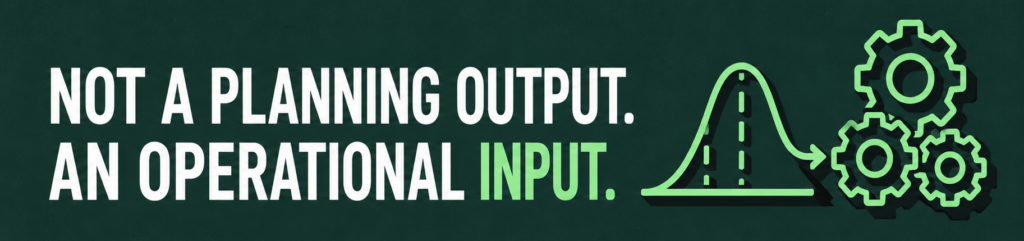
As AI becomes embedded across the supply chain, forecasts are no longer consumed by a single team. Instead, they increasingly serve as inputs to inventory optimization, replenishment, production planning, transportation planning, procurement systems, and a growing number of AI-powered applications.
A forecast is no longer just a planning output. It’s an operational input that helps both people and AI systems make decisions across the business.
For years, demand forecasting was evaluated by one question: How accurate is the forecast? Today, organizations are asking a different one: How effectively does that forecast improve decisions across planning, inventory, procurement, and operations?
Accuracy is no longer enough
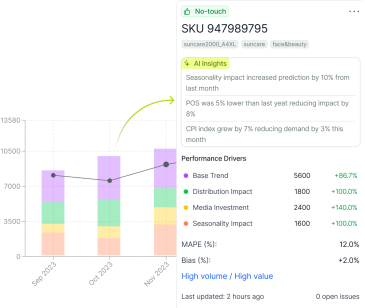
Forecast accuracy remains essential. But organizations expecting AI to take on a greater role in planning need more than an accurate number. They need to understand why demand is changing.

Is growth being driven by seasonality? A promotion? Changing customer behavior? A competitor exiting the market? Or is an unexpected spike simply an anomaly that shouldn’t influence future planning?
Answering those questions is what allows planners, and increasingly AI systems, to trust the forecast enough to act on it.
As organizations automate more business processes, explainability becomes just as important as accuracy. Forecasts need to be transparent enough for planners to validate while giving AI systems the confidence to recommend or eventually automate the right actions.
They also need to operate across multiple levels of the business, from individual SKUs and stores to regions, product families, and total categories, while supporting products with little or no historical demand.
In other words, forecasting is no longer just about producing better numbers. It’s about providing the intelligence that enables faster, more confident operations.
Why the Databricks architecture matters
One of the most interesting aspects of the Databricks architecture is that each layer is designed to depend on the one below it. A trade compliance agent can’t reason effectively without semantic context. Planning and orchestration can’t operate reliably without trusted operational data. The architecture builds upward, with each layer providing the capabilities the next layer depends on.
Demand & Predictive Intelligence sits within that architecture as the layer responsible for providing reliable, forward-looking demand signals. Procurement volumes, production schedules, inventory positioning, transportation capacity, and labor planning all depend on an organization’s best estimate of what customers will want and when.
The industry often asks what AI agents can automate. The Databricks framework encourages a different question: What capabilities do those agents depend on before they’re ready to automate anything at all? That’s an architecture question rather than a feature question, and it leads to a fundamentally different way of thinking about AI adoption. High-quality, explainable demand predictions are a key part of that answer.
Where DemandForecast.ai fits
Within the Databricks architecture, DemandForecast.ai by Pecan AI is featured as the Demand & Predictive Intelligence solution.
The ebook highlights capabilities such as multi-hierarchy forecasting, explainable predictions, new product introduction (NPI) modeling, intelligent demand understanding through anomaly and outlier detection, rapid deployment, and native integration with Databricks, Snowflake, BigQuery, and Amazon Redshift. It also showcases customer outcomes such as a 37% reduction in forecast error (MAPE) at Kenvue and an approximately 70% reduction in manual data cleansing for a large, publicly traded automotive aftermarket manufacturer managing more than 100,000 SKUs. Pecan AI was also named a 2025 Gartner Cool Vendor in Cross-Functional Supply Chain Technology for lowering the barriers to advanced analytics.
While this section of the ebook focuses on DemandForecast.ai, the broader architecture is what makes the inclusion meaningful. By positioning Demand & Predictive Intelligence as a core layer, Databricks reinforces the growing role of forecasting as an input into AI-powered planning and operations.

Looking ahead
The real promise of agentic AI isn’t replacing planners. It’s enabling better outcomes at a speed and scale that wouldn’t otherwise be possible. That promise depends on reliable data and trustworthy predictions.
For decades, demand forecasting was viewed as one step in the planning process. Increasingly, it serves as the connective layer between demand signals and operational execution. As more business processes are supported or carried out by AI, the quality of those outcomes will depend on the quality of the forecasts behind them.
Organizations evaluating agentic AI should ask not only what AI agents can automate, but whether their forecasting strategy is ready to support them.
As the industry moves toward more autonomous supply chains, demand forecasting is evolving beyond a planning discipline. It is emerging as one of the capabilities that determine whether AI-powered supply chains can scale successfully.
Read the Databricks ebook
Read The Agentic Supply Chain: From Reactive Execution to Autonomous Retail Orchestration to explore Databricks’ vision for the future of AI-powered supply chains and the role Demand & Predictive Intelligence plays within the broader architecture.
See DemandForecast.ai in action
See how DemandForecast.ai helps organizations generate explainable, production-ready demand forecasts in weeks, not months.