The Trust Gap in AI-Powered Forecasting
Traditional demand forecasting methods, while often less accurate, had one significant advantage: transparency. When a human analyst made a prediction, they could explain their reasoning based on historical data, market trends, and business knowledge. Stakeholders could understand and trust these decisions because they followed familiar patterns of human logic.
Modern AI models, particularly deep learning systems, operate as “black boxes” that process vast amounts of data to generate predictions. While these models often achieve superior accuracy, their decision-making process remains opaque to human users. This creates a trust gap that can hinder adoption and limit the potential impact of AI-powered forecasting.
Key Challenges:
- Lack of Transparency: Users can’t understand how the model arrived at its predictions
- Difficulty in Validation: Hard to verify if the model’s reasoning aligns with business logic
- Resistance to Adoption: Stakeholders may be hesitant to rely on unexplained predictions
- Compliance Issues: Regulatory requirements often demand explainable decision-making
The Power of Explainable AI in Demand Forecasting
Explainable AI bridges the trust gap by providing clear, interpretable insights into how AI models make their predictions. In the context of demand forecasting, this means stakeholders can understand not just what the model predicts, but why it made that specific prediction.
Feature Importance and Attribution
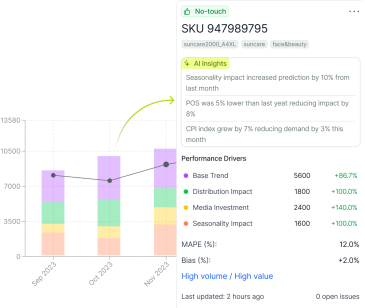
One of the most powerful aspects of explainable AI is its ability to identify which factors most significantly influence predictions. For demand forecasting, this might reveal that:
- Seasonal patterns account for 40% of the prediction
- Recent marketing campaigns contribute 25%
- Economic indicators influence 20%
- Historical sales trends determine 15%
This level of transparency allows business users to validate that the model is considering the right factors and to adjust strategies based on these insights.
Counterfactual Explanations
Explainable AI can also provide “what-if” scenarios that help users understand how changes in input variables would affect predictions. For example, the system might show that:
“If we increase our marketing budget by 20%, the model predicts a 15% increase in demand. If we reduce inventory by 10%, we might see a 5% decrease in stockouts.”
These counterfactual explanations enable more informed decision-making and help users understand the sensitivity of predictions to various factors.
Building Trust Through Transparency
Trust in AI systems is built through consistent, transparent, and reliable explanations. Here are key strategies for implementing explainable AI in demand forecasting:
1. Model Interpretability
Choose models that inherently provide interpretability, such as decision trees or linear models, when possible. For more complex models, implement techniques like SHAP (SHapley Additive exPlanations) or LIME (Local Interpretable Model-agnostic Explanations) to generate explanations.
2. Human-AI Collaboration
Design systems that allow human experts to review and validate AI predictions. This collaborative approach combines the speed and accuracy of AI with the domain expertise and intuition of human analysts.
3. Continuous Learning and Feedback
Implement feedback loops where users can provide input on the accuracy and usefulness of explanations. This helps improve both the model’s performance and the quality of explanations over time.
Real-World Impact: Success Stories
Companies that have implemented explainable AI in their demand forecasting have seen significant improvements in adoption and trust:
Case Study: Retail Chain
A major retail chain implemented explainable AI for demand forecasting and saw:
- 85% increase in forecast adoption by store managers
- 30% improvement in forecast accuracy through human-AI collaboration
- 60% reduction in time spent on forecast validation
The Future of Explainable Demand Forecasting
As AI technology continues to evolve, explainability will become even more critical. Future developments in explainable AI will likely include:
- Real-time Explanations: Instant explanations as predictions are made
- Natural Language Explanations: AI systems that can explain predictions in plain English
- Interactive Explanations: Users can ask follow-up questions about predictions
- Visual Explanations: Intuitive charts and graphs that illustrate model reasoning
Conclusion
Building trust in AI-powered demand forecasting is not just about improving accuracy—it’s about creating systems that users can understand, validate, and confidently rely upon. Explainable AI provides the transparency needed to bridge the gap between sophisticated machine learning models and human decision-makers.
As organizations continue to adopt AI for demand forecasting, those that prioritize explainability will gain a significant competitive advantage. They’ll not only achieve better forecasting accuracy but also build stronger trust with stakeholders, leading to faster adoption and more effective use of AI insights.
The future of demand forecasting lies in the intersection of powerful AI capabilities and human understanding. By embracing explainable AI, organizations can unlock the full potential of machine learning while maintaining the trust and confidence of their teams.